
ADMINISTRATIVE POLICY
Policy Statement
This document sets out the policy, authorities and requirements for retaining design professionals and construction contractors for facilities work carried out in university-owned and operated facilities. The intent of this policy is to ensure that selection and engagement of design professionals, contractors, etc. for work related to facilities is in compliance with university policies and procedures, the policies and procedures contained in the Tulane University Project Performance Guidelines and that all work complies with applicable laws, regulations, and building and life safety codes.
This policy will also ensure that all facility projects, including feasibility studies, are aligned with institutional as well as Tulane strategic goals and objectives, and will help ensure that limited resources are targeted to institutional priorities.
Purpose and Scope
The intent of this policy is to ensure that work related to facilities, including the purchase of Fixtures, Furnishings, and Equipment (FFE) complies with established building and life safety codes, University policies and procedures, Tulane University
Project Performance Guidelines, and that all work complies with applicable laws, regulations, and building and safety codes. This policy governs who may perform work in Tulane facilities and how to request, review, approve, and execute that work to ensure safety, compliance, stewardship, and transparency across all campuses and leased spaces.
This policy will also ensure that all facility projects are aligned with institutional strategic goals and objectives, and to help ensure that limited resources are targeted to institutional priorities and are deployed in a cost-effective manner that bolsters more effective space utilization.
All work performed must be in accordance with these requirements under proper authorization.
This Policy does not apply to the construction of new buildings, which may only be authorized by senior University administration, with the approval of the Board of Administrators.
Applicability of this Policy
This policy applies to all members of the Tulane Community and all facilities owned or leased by Tulane University.
Definitions
7.1 Contractor: A company that possesses the required State licenses to perform construction related work and may be a General Contractor, Construction Manager, Design-Builder, or a subcontractor.
7.2 Construction: The act of moving, demolishing, renovating, installing, or building a structure, facility, or system according to a plan or by definite process. This includes construction, addition, expansion, renovation, or removal. Construction consists of the application of any of these techniques to facilities such as structures, utilities, excavations, landscaping, site improvements, drainage systems, and roads.
7.3 Construction Project: Construction relating to additions to, and renovations of, existing University facilities, excluding Repairs and Maintenance. Construction Projects typically cost $10,000 or more.
7.4 Design Professional: An architect or engineer or an architectural or engineering firm including, but not limited to, architects, civil, structural, mechanical, electrical, plumbing, heating, ventilating, and air conditioning engineers; interior designers; landscape architects, surveyors; industrial hygienists; and others whose services are considered "professional" activities requiring licensing or registration by the state, or otherwise require the knowledge and application of design principles appropriate to the proposed work at hand. The Design Professional for any given project contract is typically the lead design member for the project team.
7.5 Facilities: Resident Instruction Facilities and Non-Resident Instruction Facilities.
7.6 FCD: Facilities and Campus Development department of Tulane.
7.7 Fixtures, Furnishings, & Equipment (FFE): Furniture, fixtures, and equipment refers to movable furniture, fixtures, or other equipment that have no permanent connection to the structure of a building. These items, which include desks, chairs, electronic equipment, tables, bookcases, and partitions.
7.8 Initiator: A Tulane affiliated person. The initiator submits the request for work through their respective department via the University Project Request Form located on the Tulane Service Now IT portal at https://campusservices.tulane.edu/request-project.
7.9 Maintenance: The upkeep of property, machinery, and facilities, including buildings, utility systems, roads, and grounds. It is characterized by its routine or recurring nature, the purpose of which is to keep facilities and systems functional. If the property is used for Resident Instruction and the project is deemed routine maintenance, it will be performed by or under the supervision of FCD. If the act of performing maintenance requires alterations and reconfigurations that vary from the existing installation layout or impacts exterior appearance, it shall be considered Construction. Maintenance work typically costs less than $10,000.
7.10 Phasing: The practice of splitting a project up into smaller, less expensive parts to avoid going over an approval threshold. For example: Placing a work order to do each portion (e.g. electrical, structural, painting and carpeting) of a project separately, so that the parts of work do not require higher-level approval, when if done together as a single project the project would require a higher-level approval.
7.11 Repair: The restoration of property, machinery, systems, and facilities to proper working order, including buildings, roads, and grounds, and their components. Examples include fixing a leaking roof, broken window, or damaged piece of installed building equipment. It also includes repair by replacement-in-kind (i.e., replacing a 10-ton a/c unit with another 10-ton a/c unit).
7.12 Resident Instruction: Instruction that takes place in person, rather than remotely or on-line.
7.13 Resident Instruction Facilities: Facilities that are (i) primarily used for providing resident instruction or are primarily research focused, (ii) used for the administration and support of resident instruction, (iii) all campus utility infrastructure, and (iv) all roads, hardscape and grounds in and around these same facilities.
7.14 Non-Resident Instruction Facilities: Facilities that are under the control of Tulane business units that may generate revenue to support University operations, e.g. Athletics, Auxiliary Services, Parking, Food Services, and Housing.
7.15 Project: For purposes of this policy, “Project” includes Repairs, Maintenance, and Construction Projects, as well as acquisition of FFE.
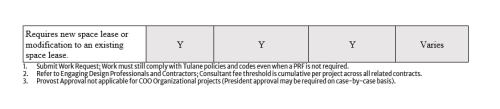
7.16 COO/Provost: Senior approvers for Projects as specified in the approval matrix below
7.17 Change in Use of Space: A change that alters occupant load, egress, fire rating, or MEP system demands; requires review by the Office of University Architect (OUA).
7.18 Task Order Contract: A pre-qualified, negotiated-rate agreement used by F&CD to engage design professionals or contractors for defined scopes. F&CD may halt unapproved phased work and consolidate scopes for proper review; costs may be recharged to the Initiator’s department.
7.19 Work Order: A service request routed to Facilities Services (FS) for Maintenance and Repair activities.
7.20 Project Request Form (PRF): The official online form used to request work managed by Facilities & Campus Development (F&CD).
7.21 Work: This may be defined as either construction, design, or design studies that require the use of a Contractor or Design Professional.
Policy and Procedures
8.1 Departments/units which have identified Projects or Work requiring the services of Design Professionals or Contractors shall follow these Procedures:
The Initiator (see Policy Definitions) shall complete the “Project Request Form” form (link below) and submit the proposed project through the routing outlined therein.
https://campusservices.tulane.edu/request-project.
This request must be approved by the department’s Dean or Vice President before it is routed to the COO or to the Provost (if required) for review. This approval may not be delegated.
8.2 Phasing a Project to avoid funding threshold approvals is forbidden. Each Project request shall result in a complete and usable, fully functional product.
8.3 Facility Initiation Review/ Approval Matrix


8.4 Responsibilities
8.4.1 The Vice President for Facilities and Campus Development (VPFCD) is responsible for all Tulane University facilities, including but not limited to operation and maintenance, repairs, construction, renovations, alterations and demolition.
8.4.2 The Office of the University Architect (OUA) is responsible for planning the long-range development of the campus. OUA makes continuous studies of the physical needs of the University and coordinates the planning and construction of physical facilities. Present and future facility needs are determined by working closely with the various instructional and administrative departments. The office assembles all requests and analyzes all plans for expansion of facilities, alterations, and changes, which affect the exterior appearance of the campus. OUA also oversees and advises on new construction or capital improvement projects. OUA also provides design and planning support for Auxiliary and Administrative Services departments, Athletics, Housing and other campus organizations, and such other duties as may be assigned by the VPFCD.
8.4.3 The Office of Planning, Design, and Construction is responsible for all capital construction and design for Tulane Facilities. This includes new construction, renovation, alteration and major capital repairs.
8.4.4 The Associate Vice Presidents for Facilities Services (FS) are responsible for the operation and maintenance of the university's facilities. This encompasses responsibility for building maintenance and repairs, building alterations, maintenance of mechanical and electrical systems, custodial services, and related activities. Additional responsibilities include operation of the steam and chiller plants and construction, operation, and maintenance of utility systems, providing engineering support, and operation of a warehouse. Other responsibilities include maintenance of roads and grounds, landscaping, maintaining an inventory of university buildings and land, vehicle rental pool, and automotive maintenance shops. FS ensures facilities are operated and maintained in a technically and fiscally responsible manner, ensuring energy efficiency, life safety, and ADA compliance. FS also provides engineering and maintenance support for Auxiliary and Administrative Services departments, Athletics, Housing and other campus organizations, and such other duties as may be assigned by the Vice President for Facilities and Campus Development.
8.4.5 The Vice President of Real Estate and Auxiliary Services oversees all University real estate transactions and is responsible for coordinating and managing all real estate purchase, sale and lease agreements.
8.4.6 The Director of Space Management, under the direction of the University Architect, receives all requests for space and coordinates with the Office of the Provost on such requests to ensure space allocation occurs in a fair and transparent manner while simultaneously addressing the university’s strategic goals. Approved requests for space and the resulting changes of any such approval are coordinated through Space Management. Additionally, Space Management coordinates requests for demolition.
8.4.7 Facilities and Campus Development is responsible for the procurement of supplies, materials, equipment and contractual services related to any work on Tulane owned or leased real estate. This office has responsibility, within the University, for negotiating, preparing, executing or recommending execution, awarding and administering all contracts, purchase orders and rental agreements which involve expenditures on supplies, materials, equipment and contractual services for Tulane owned or leased real estate.
8.4.8 The Office of Research, including but not limited to the Office of Research Proposal Development, Research Administration Service Units, and Sponsored Projects Administration, is responsible for contacting if an application for or award of a grant or contract to be administered by the Office of Research (“External Award”) includes funding for a Project subject to this policy. Similarly, if an External Award is discussed as a potential funding mechanism for a Project being developed in accordance with this policy, the Tulane stakeholders for such Project are responsible for contacting the Vice President for Research or a designee thereof. The Office of Research is responsible for assisting with the preparation of External Award applications, submitting External Award applications, and advising other Tulane stakeholders of an External Award’s compliance obligations so that the appropriate Tulane stakeholder can be identified for fulfilling each obligation. In the event of a conflict or inconsistency between this policy and the terms and conditions of an External Award, the latter will control.
8.5 Procedures: Maintenance or Repair Work Order is typically <$10,000; Maintenance, Repair, and Construction Projects are typically ≥$10,000; design professional engagement ≥$2,500. Thresholds align with the Tulane University Purchasing Policy and Procedures Manual; if stamped drawings or permits are required at any dollar amount, route as a Project.
Step 1: Submit a PRF.
Step 2: Obtain Dean/VP approval (non‑delegable).
Step 3: F&CD intake and assignment.
Step 4: Route to COO/Provost when required.
Step 5: F&CD communicates approvals and next steps.
All work must coordinate life‑safety impairments and hot‑work with Facilities Services/EH&S, follow lockout/tagout and hazardous materials protocols, and comply with City/Parish permits and Louisiana contractor licensing.
Consequence of Violating the Policy
Violation of this policy may result in disciplinary action, up to and including termination. For consequences of violating the policy refer to the Faculty and Staff handbooks found at https://hr.tulane.edu/staff-handbook and https://provost.tulane.edu/academic-affairs/policies/faculty-handbook. Vendors/contractors performing unapproved work may be removed from campus projects and departments will be held responsible for corrective costs.